Table of Contents
ToggleMost bedrooms waste a massive volume of vertical space. That empty zone between the floor and your mattress? It’s prime real estate for storage, roughly 20-30 cubic feet per queen-size bed. Decked bed storage transforms that dead air into functional organization by incorporating drawers, lift-up compartments, or platform cubbies directly into the bed frame. It’s not new furniture: it’s a strategy to reclaim square footage without expanding your footprint. For small bedrooms, studio apartments, or anyone tired of overstuffed closets, this approach delivers serious organizational firepower.
Key Takeaways
- Decked bed storage transforms the 20-30 cubic feet of unused space beneath your mattress into functional organization using drawers, lift-up compartments, or platform cubbies, reclaiming square footage without expanding your bedroom footprint.
- Drawer-style beds offer 15-20 cubic feet of storage with smooth ball-bearing glides and are ideal for weekly access, while lift-up hydraulic beds provide 25-40 cubic feet of cavernous space perfect for bulky seasonal items and long-term storage.
- DIY decked bed storage projects save $300-800 compared to retail prices and can be completed as an intermediate weekend project using basic lumber, plywood, screws, and standard woodworking tools.
- Proper organization of decked bed storage requires drawer dividers, seasonal rotation, dust protection with vacuum-sealed bags, and even weight distribution to ensure smooth operation and prevent frame stress.
- Measure your bedroom clearance carefully—drawer beds need 18 inches of pull-out space while lift-up beds require 18-24 inches of rear or side swing room, and ensure your frame can safely support 600+ pounds of distributed load.
What Is Decked Bed Storage and Why Does It Matter?
Decked bed storage refers to any bed frame designed with built-in storage compartments beneath or within the sleeping platform. Instead of a traditional frame with empty space underneath, these beds integrate drawers, lift-up platforms, or open cubbies into the structure itself. The term “decked” references the platform deck (the flat surface supporting the mattress), which sits atop the storage system.
This design matters because residential bedrooms are getting smaller while our stuff isn’t. The average U.S. master bedroom is roughly 200-250 square feet, and secondary bedrooms clock in closer to 120-150 square feet. When closets can’t handle seasonal clothing, extra bedding, or sports gear, the space under your bed becomes critical.
Beyond square footage, decked bed storage eliminates floor clutter. No more plastic bins sliding around on carpet or dust bunnies colonizing the gap beneath your frame. Everything stays enclosed, accessible, and organized. For renters who can’t add built-in closets or homeowners avoiding costly renovations, it’s a high-impact, low-commitment solution.
Types of Decked Bed Storage Solutions
Not all decked beds are created equal. The right type depends on your storage needs, bedroom layout, and how often you’ll access the contents.
Built-In Drawers and Platform Storage
Drawer-style decked beds are the workhorse option. They feature pull-out drawers (typically 2-6 per frame) built into the sides or footboard. Most drawers run on ball-bearing glides for smooth operation, and quality models include dust-proof bottoms to keep linens clean.
Typical drawer dimensions: 12-18 inches deep, 24-36 inches wide, and 6-10 inches tall. A queen frame with four drawers offers roughly 15-20 cubic feet of storage, enough for off-season clothing, extra blankets, or shoes.
Platform storage beds skip the drawers and provide open cubbies or shelves beneath a raised deck. These work well for items you grab frequently (like books or gym bags) but aren’t ideal for dust-sensitive storage. Many DIYers prefer building platform styles because they require fewer precision cuts and no drawer hardware.
For projects centered around full size storage bed frames, drawer configurations are popular in kid’s rooms and guest suites.
Lift-Up Hydraulic Storage Beds
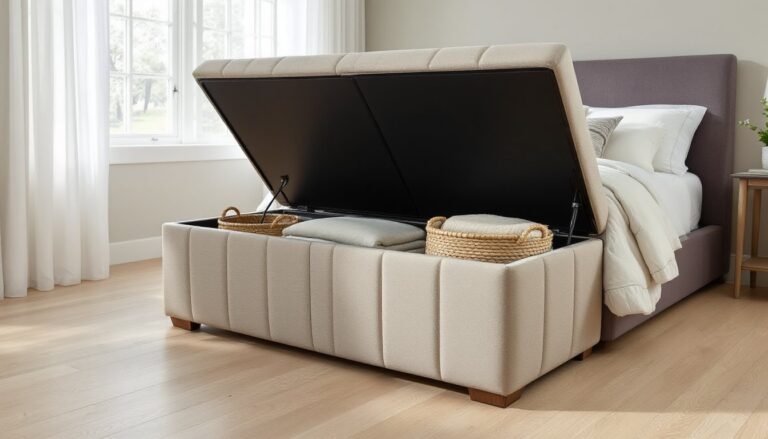
Lift-up beds (also called ottoman beds or gas-lift beds) hinge the entire mattress platform upward, revealing a cavernous storage compartment underneath. Gas struts or hydraulic pistons do the heavy lifting, so raising a queen mattress takes minimal effort.
Storage capacity: 25-40 cubic feet for a queen frame, significantly more than drawer models. The entire footprint beneath the mattress becomes usable space, perfect for bulky items like luggage, seasonal decorations, or camping gear.
Trade-offs: You’ll need to remove bedding to access storage, and the mechanism adds cost (expect $100-200 for quality lift kits if building DIY). Clearance behind or beside the bed is also essential: the platform needs 18-24 inches of swing room when lifted. These aren’t beginner-friendly builds, precision alignment is critical for smooth operation and safety.
How to Choose the Right Decked Bed Storage for Your Bedroom
Start by measuring your available clearance. Standard bed height (floor to mattress top) is 24-26 inches. Decked beds with drawers typically sit 18-22 inches high, leaving 10-14 inches of drawer interior space after accounting for the deck thickness and mattress.
Lift-up beds need taller profiles, usually 16-20 inches from floor to deck, to maximize storage volume. Measure ceiling height if you’re building a loft-style decked bed: you’ll want at least 36 inches of clearance above the mattress for sitting upright comfortably.
Access patterns matter. If you’ll retrieve items weekly, drawers or platform cubbies make sense. For long-term storage (holiday décor, archived files), a lift-up system works fine even though the access friction.
Consider bedroom layout. Drawer beds require pull-out clearance, at least 18 inches on the drawer side, more if the room doubles as a walkway. Lift-up beds need rear or side clearance for the platform swing. Sketch your floor plan with clearances marked before committing.
Weight capacity is non-negotiable. A queen mattress weighs 60-100 pounds, and two adults add another 300-400 pounds. Your decked frame must handle 600+ pounds of distributed load. Use 2×6 or 2×8 framing lumber for primary support beams, and space cross-supports every 24 inches maximum. If you’re unsure about structural math, building guides for multifunctional storage often include load calculations.
Finally, match the design to your skill level. Drawer beds require dado cuts, drawer glides, and square assembly. Platform beds are more forgiving for beginners. Lift-up beds demand precise hinge placement and gas strut installation, mistakes here mean a mattress that won’t stay open or, worse, slams shut.
DIY Decked Bed Storage: Building Your Own Space-Saving Solution
Building a decked storage bed is an intermediate weekend project. You’ll save $300-800 compared to retail prices, and you can customize dimensions to fit odd room layouts or specific storage needs.
Materials for a queen-size platform storage bed:
- (2) 2×8 x 8′ boards (side rails)
- (3) 2×6 x 8′ boards (cross supports and footboard)
- (1) 4×8 sheet of 3/4-inch plywood (deck surface)
- (8) 2×2 x 8′ boards (cubby dividers, optional)
- 2.5-inch wood screws and 3-inch structural screws
- Wood glue
- Sandpaper (80-grit and 120-grit)
- Paint or stain
Tools needed:
- Circular saw (or miter saw for cleaner cuts)
- Drill/driver with bits
- Tape measure and carpenter’s square
- Level (critical for even support)
- Safety glasses and ear protection
Step-by-step:
- Cut side rails to 80 inches (queen length). Cut the footboard to 60 inches (queen width).
- Assemble the frame by attaching the footboard between the side rails using 3-inch screws and glue. The frame should measure 60 x 80 inches inside.
- Install cross supports every 24 inches along the length, running perpendicular to the side rails. Use joist hangers or screw through the side rails at an angle (pocket holes work well).
- Add cubby dividers if desired. Cut 2x2s to fit between cross supports, creating compartments for shoes, books, or bins.
- Cut the plywood deck to 60 x 80 inches. Lay it across the frame and screw down every 12 inches along the perimeter and at each cross support.
- Sand and finish. Hit all edges with 80-grit, then smooth with 120-grit. Apply paint, stain, or polyurethane.
- Add feet or casters if you want mobility or additional height. Locking casters (rated for 500+ pounds) make cleaning underneath easier.
For drawer functionality, you’ll need to frame out drawer boxes and install side-mount or undermount slides. Plans for elevator beds with storage show advanced mechanisms, but basic drawers are simpler: build boxes from 1×6 boards, attach the glides, and mount them to the bed frame.
Permit check: In most jurisdictions, furniture building doesn’t require permits unless it’s permanently attached to walls or ceiling joists. Always verify local codes if you’re anchoring a loft bed to studs.
Beginner builders should start with simpler projects. Resources like Fix This Build That and The Handyman’s Daughter offer step-by-step tutorials for foundational woodworking techniques.
Organization Tips to Maximize Your Decked Bed Storage
Building or buying decked storage is step one. Maximizing its utility requires intentional organization.
Use drawer dividers. Fabric bins, adjustable dividers, or storage cubes keep small items from migrating into corner chaos. Label each section, “winter scarves,” “chargers,” “guest linens”, so everyone in the household knows where things live.
Store by frequency. Items you access monthly (seasonal clothes, extra pillows) go in the easiest-to-reach drawers or front cubbies. Rarely used gear (holiday décor, archived documents) can live in lift-up compartments or back corners of platform storage.
Protect against dust and moisture. Even enclosed drawers aren’t airtight. Use vacuum-sealed bags for off-season clothing or bedding. For basements or humid climates, toss in silica gel packets to prevent mildew. If your bedroom doubles as basement storage overflow, moisture control is critical.
Maximize vertical stacking. Shallow bins or folded items stack better than loose piles. Rolling clothes instead of folding saves space and reduces wrinkles, a technique borrowed from travel packing that works brilliantly in shallow drawers.
Audit seasonally. Twice a year, pull everything out and reassess. Donate items you haven’t used in 12 months. Rotate seasonal gear to accessible spots. This prevents the dreaded “storage black hole” where things vanish forever.
Finally, keep weight distribution even. Don’t overload one side of a drawer bed: it stresses the glides and can rack the frame out of square. If using plastic bins, choose ones sized to fit your compartments, standard Home Depot storage containers come in modular dimensions that nest well in DIY cubbies.
Safety note: Never store flammable materials (paint cans, propane canisters) under a bed. Keep emergency exits clear, and avoid overstuffing lift-up beds to the point where the struts can’t handle the load. A properly organized decked bed should close and open smoothly, if it’s a struggle, you’ve exceeded capacity.