Table of Contents
ToggleMost bathroom cabinets hide a mess, a tangle of hair products, half-used tubes, and mystery bottles shoved wherever they fit. The average bathroom vanity has about 12–18 cubic feet of storage potential, but without a system, most of that space goes to waste. Good news: you don’t need a full remodel or custom cabinetry to fix it. With a handful of inexpensive organizers and a few smart tweaks, anyone can turn chaos into calm. This guide walks through fifteen practical, field-tested ideas to reclaim every inch of cabinet real estate, from vertical risers to turntables and beyond.
Key Takeaways
- Bathroom cabinet storage ideas like stackable risers and pull-out drawers can double or triple usable space without requiring expensive renovations.
- Utilize vertical space by installing adjustable-height organizers with taller items on bottom tiers and smaller products on top to keep everything visible and accessible.
- Door-mounted organizers and adhesive-mount baskets add hidden storage capacity while freeing up interior cabinet space for larger supplies.
- Clear containers and labeled drawer dividers reduce search time and prevent clutter by organizing items into dedicated zones by category.
- Lazy Susans and turntables transform corner cabinets and deep shelves into functional storage areas where a single spin brings hard-to-reach items forward.
- Repurpose everyday items like mason jars, magazine holders, and shower caddies as budget-friendly alternatives to branded organizers, saving money while maximizing functionality.
Utilize Vertical Space with Stackable Organizers
Standard vanity cabinets typically measure 18–24 inches deep and 30–36 inches wide, but the vertical dimension, often 24–30 inches, gets ignored. Stackable shelf risers or tiered organizers double or triple usable surface area by creating distinct “floors” inside the cabinet.
Look for adjustable-height risers made from coated wire or molded plastic. Wire models allow airflow (critical for damp bathrooms), while plastic versions offer a cleaner look and are easier to wipe down. Units with expandable width, typically 12–24 inches, fit cabinets of varying sizes without gaps.
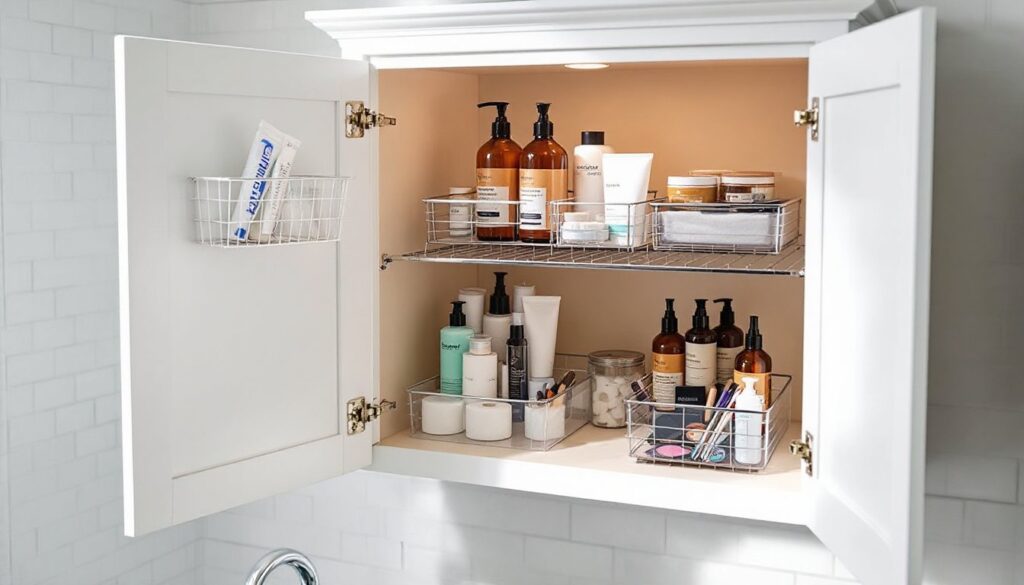
Install risers in graduated heights: place taller bottles (shampoo, conditioner) on the bottom tier, mid-height items (lotions, sprays) on the middle, and small jars or compacts on top. This keeps everything visible and prevents the “dig-and-dump” cycle that creates clutter.
Safety note: Avoid overloading. Most plastic risers support 10–15 pounds per shelf: wire models handle slightly more. Distribute weight evenly to prevent tipping.
Add Pull-Out Drawers and Sliding Shelves
Fixed shelves in deep cabinets turn the back six inches into a black hole. Pull-out drawers and sliding shelf inserts solve this by bringing every item to you.
Retrofit options come in two flavors:
- Drawer-style baskets: Wire or plastic units mounted on ball-bearing glides. Measure your cabinet’s interior width (not the door opening) and subtract 1 inch for clearance. Common widths are 11, 14, and 17 inches. Depth should be 2 inches less than the cabinet to avoid hitting the back wall.
- Sliding shelf platforms: Flat trays on runners, ideal for storing cleaning supplies or backup toiletries. These typically mount to the cabinet floor with screws (pre-drill pilot holes to avoid splitting particleboard).
Installation is straightforward: Mark mounting points with a level, drill, and fasten with the included hardware. If your cabinet has a center stile (vertical divider), you may need a narrower unit or two side-by-side drawers.
Ball-bearing glides rated for 75–100 pounds are overkill for bathroom use but ensure smooth operation for years. Look for soft-close features if you’re tired of slamming drawers at 6 a.m.
This approach mirrors the logic behind many Home Depot Bathroom Storage solutions, which prioritize accessibility in tight quarters.
Install Door-Mounted Organizers for Hidden Storage
Cabinet doors are prime real estate that most people ignore. Over-the-door racks and adhesive-mount baskets add storage without touching the cabinet interior.
Choose organizers based on door construction:
- Over-the-door hooks: Work on any door thickness (typically 3/4 to 1 inch). These hang on the door’s top edge and hold wire baskets, towel bars, or small shelves. Weight capacity varies, cheaper models max out at 5 pounds: reinforced versions handle 15+.
- Adhesive-mount baskets: Best for frameless (European-style) cabinets where over-the-door hooks interfere with hinges. Use heavy-duty adhesive strips rated for humid environments. Clean the door surface with isopropyl alcohol before applying to ensure a strong bond.
Before installing, check door swing clearance. Measure the distance between the open door’s interior face and any adjacent walls, fixtures, or vanity edges. Most door organizers add 3–4 inches of depth. If clearance is tight, opt for shallow models (2–2.5 inches deep).
Ideal items for door storage: hair tools, travel-size toiletries, cleaning cloths, and frequently used items like toothpaste or deodorant. Avoid storing heavy glass bottles, vibration from repeated door closing can crack them or weaken adhesive mounts.
Some under-the-sink organization strategies recommend door-mounted solutions to free up shelf space for bulkier supplies.
Use Clear Containers and Drawer Dividers
Clear acrylic or polystyrene bins let you see what’s inside without opening lids, critical when you’re hunting for cotton swabs mid-routine. Choose stackable models with interlocking lids to maximize vertical space.
Common sizes for bathroom use:
- Small bins (4×6 inches): Cotton balls, swabs, hair ties.
- Medium bins (6×9 inches): Makeup palettes, skincare bottles, razors.
- Large bins (9×12 inches): Backup shampoo, bulk toilet paper rolls, cleaning supplies.
Drawer dividers keep items from sliding into a jumbled mess. Adjustable dividers (spring-loaded or expandable) fit drawer widths from 12–24 inches and let you customize compartment sizes. Bamboo or plastic options both work: bamboo looks sharper but costs 20–30% more.
For vanity drawers, dedicate compartments by category: hair tools in one, skincare in another, makeup in a third. This cuts search time and prevents the “avalanche effect” when you open the drawer.
Pro tip: Label bins with a label maker or adhesive chalkboard tags. It sounds excessive, but it keeps everyone in the household accountable and reduces “where’s the…?” questions.
This modular approach is the same reason small bathroom counter decorating emphasizes defined zones, visual clarity reduces perceived clutter.
Incorporate Lazy Susans and Turntables
Lazy Susans transform corner cabinets and deep shelves from frustrating dead zones into functional storage. A good turntable brings back-row items to the front with a single spin.
Choose the right diameter:
- 9-inch models: Fit narrow cabinets (12–15 inches wide) and hold small bottles, jars, or medications.
- 12-inch models: Standard size for most vanity cabinets. Accommodate mid-size bottles and grouped items.
- 16-inch models: Best for under-sink cabinets or wide shelves. Handle bulkier products like hairspray, lotion pumps, or cleaning supplies.
Materials matter in damp environments. Plastic Lazy Susans resist moisture and clean easily but can crack under heavy loads. Coated metal or stainless steel turntables handle more weight (20+ pounds) and last longer. Avoid uncoated wood, it warps and harbors mold in humid bathrooms.
For under-sink cabinets, measure around the drainpipe. Two-tier Lazy Susans with a cutout center accommodate plumbing while maximizing storage. Place cleaning products on the bottom tier, daily-use items (hand soap refills, extra towels) on top.
Safety reminder: Secure heavy or glass bottles toward the center of the turntable to prevent tipping during rotation. Test the spin before loading fully, some budget models have cheap bearings that bind or wobble.
Many home organization guides highlight turntables as one of the simplest, highest-impact upgrades for any cabinet.
Repurpose Everyday Items for Creative Storage
Before buying more plastic bins, raid the kitchen and garage. Mason jars, magazine holders, shower caddies, and utensil trays all translate beautifully to bathroom storage, and cost pennies compared to branded organizers.
Mason jars (pint or quart size) hold cotton balls, swabs, bath salts, or makeup brushes. Mount jar lids under a shelf or cabinet ceiling with #6 wood screws (pre-drill to avoid cracking), then twist jars into place for suspended storage. This works especially well in shallow cabinets where floor space is tight.
Magazine holders (wire or cardboard) corral flat irons, curling irons, and blow dryers. Mount them sideways on a cabinet door or stand them upright on a shelf. The open top makes grabbing tools quick, and ventilation prevents heat damage.
Shower caddies (the hanging kind) can hang inside cabinet doors or on command hooks inside the cabinet. Use them for travel-size bottles, razors, or sponges. Rust-resistant stainless steel or coated wire models last longest.
Utensil trays from the kitchen aisle make excellent drawer organizers for makeup, nail tools, or grooming kits. They’re cheaper than purpose-built bathroom dividers and often have better compartment layouts.
Magnetic strips (the kind used for knife storage) stick to the inside of metal cabinet doors and hold metal grooming tools, tweezers, nail clippers, bobby pins. Use heavy-duty adhesive-backed magnets if your doors are wood or laminate.
These low-cost hacks echo ideas found on design platforms where creativity trumps budget. The same principles that apply to home gym storage work here: use what you have, adapt to the space, and prioritize accessibility.
Conclusion
Bathroom cabinet storage doesn’t require a gut renovation or a four-figure investment. Most clutter stems from underused vertical space, inaccessible corners, and a lack of defined zones. Stackable risers, pull-out drawers, door organizers, clear bins, turntables, and repurposed household items handle 90% of storage challenges for under $100 total. Measure twice, install once, and group items by frequency of use, daily essentials up front, backups and seasonal products toward the rear. The payoff is a calmer morning routine and a cabinet you can actually navigate without a headlamp.