Table of Contents
ToggleToys have a way of migrating from playrooms into every corner of the house, especially the living room. Between building blocks wedged under the couch, stuffed animals claiming the armchair, and action figures staging battles on the coffee table, adult spaces become kid zones fast. Hidden storage isn’t about denying that kids live in your home: it’s about creating systems that let everyone coexist without tripping over Legos during movie night. The right solutions blend into your existing decor while keeping cleanup quick and giving toys a proper home when playtime ends.
Key Takeaways
- Hidden toy storage for living rooms maintains adult aesthetics while keeping shared spaces functional by blending storage solutions into existing decor rather than using bright plastic bins.
- Storage ottomans, coffee tables with lift-tops, and built-in benches offer practical hidden storage solutions that double as furniture, with ottomans providing 3-4 cubic feet and lift-top tables holding up to 8 cubic feet.
- Disguised storage options like sideboards, console tables, vintage trunks, and decorative cubes hide toys while adding intentional design elements that guests won’t recognize as toy storage.
- Built-in window seats and benches require proper ventilation if placed near radiators or HVAC vents, soft-close hinges for safety, and should use piano hinges for lids longer than 36 inches.
- DIY hidden toy storage projects like hollow ottomans, flip-top window seats, and faux drawer fronts can be completed in 4-8 hours with basic tools and cost $60-100 in materials.
- Any tall, narrow furniture taller than 30 inches must be anchored to wall studs with furniture straps to prevent tip-over hazards and protect children in households.
Why Hidden Toy Storage Matters in Your Living Room
Open bins and bright plastic crates work fine in dedicated playrooms, but they turn living rooms into visual chaos. The living room typically serves multiple functions, family hangout, guest reception, TV viewing, and often the only downstairs gathering space. When toy storage blends with furniture, the room maintains its adult aesthetic while still being kid-friendly.
Hidden storage also protects toys from dust and pet hair, extends their lifespan, and makes it easier to rotate what’s accessible. Kids focus better with fewer choices visible at once, and parents don’t spend mental energy looking at clutter every time they sit down.
The key difference between hidden and disguised storage: hidden means completely out of sight (inside furniture, behind panels), while disguised means storage that looks like something else (decorative baskets, vintage trunks). Both approaches work, it depends on your tolerance for visible containers and how much you’re willing to invest in custom or multi-purpose furniture.
Ottoman and Coffee Table Storage Solutions
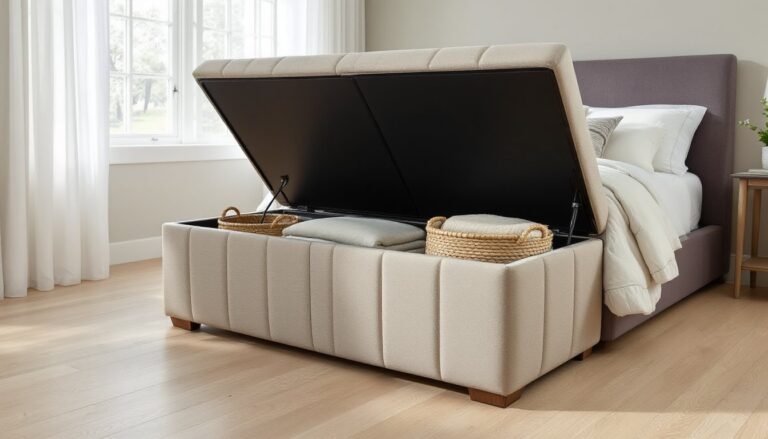
Storage ottomans are the fastest win for hidden toy storage. Look for models with lift-top lids and interior volumes of at least 3-4 cubic feet to hold a meaningful amount of toys. Upholstered versions in neutral fabrics (linen, performance velvet, leather) blend with most decor styles. Avoid tufted tops if you plan to use the ottoman as a footrest, they’re harder to clean and less stable for trays.
Square ottomans (30″x30″ or larger) offer more storage volume than round ones and can double as extra seating when guests visit. Many homeowners are shifting to multifunctional furniture that serves multiple purposes in shared spaces. If you have toddlers, choose ottomans with slow-close hinges to prevent pinched fingers. Avoid models with sharp corners, rounded edges are safer in high-traffic areas.
Coffee tables with hidden compartments come in two main types: lift-top tables (the surface raises to reveal storage underneath) and drawer/shelf hybrids. Lift-top models typically offer 6-8 cubic feet of storage and work well for larger toys like building sets or board games. The lifted top can also serve as a work surface for crafts or snacks.
Drawer-style coffee tables keep smaller toys organized, look for models with full-extension drawer slides rated for at least 50 lbs so drawers don’t sag or stick when loaded with toys. Match the table finish to your existing furniture (walnut, oak, painted finishes) so it feels intentional, not like an obvious kid furniture insertion.
Built-In Storage Benches and Window Seats
Built-in benches transform dead space, under windows, along walls, in alcoves, into high-capacity storage. A typical 48″ bench with a 15″ deep seat and 18″ internal height holds approximately 7-8 cubic feet of toys, equivalent to three or four large plastic bins.
Construction involves framing a base box from 2×4 lumber (actual dimensions 1.5″x3.5″), adding 3/4″ plywood top and sides, and finishing with a hinged upholstered lid or individual lift panels. Use continuous (piano) hinges for lids longer than 36″ to prevent sagging. Include soft-close lid supports to avoid slammed fingers.
For window seats, verify the wall isn’t load-bearing before cutting into it. If the space sits under a window with radiators or heating vents, add ventilation holes (minimum 1″ diameter, spaced every 6-8″) in the bench front to maintain airflow. This isn’t optional, blocking heat sources causes efficiency loss and potential damage.
Finish benches with washable cushions using high-density foam (at least 3″ thick, density rating 1.8 lbs/cubic foot or higher) covered in performance fabrics like Crypton or Sunbrella that resist stains and moisture. Add decorative pillows to tie the bench into your room’s color scheme, guests won’t realize it’s toy storage unless you tell them.
Permit requirements: Most jurisdictions don’t require permits for non-structural built-ins, but if you’re modifying walls, adding electrical for reading lights, or working near HVAC, check local codes first.
Disguised Storage Furniture That Blends With Your Decor
Console tables with closed cabinets work behind sofas or along walls. Standard console depth runs 12-18″, which fits board games, art supplies, and medium toys but not large stuffed animals. Look for models with adjustable shelving inside so you can configure compartments as toy sizes change.
Sideboards and credenzas offer serious storage volume, 60-72″ wide models provide 20-30 cubic feet of space. The closed-door design completely hides contents, and the flat top surface displays decor, family photos, or a table lamp. Mid-century modern styles with tapered legs feel less heavy in living rooms than traditional hutch-style pieces.
Some families embrace the IKEA BESTÅ system to create custom cabinet configurations that look like intentional built-ins. The modular design allows mixing drawer units, shelf units, and closed cabinets to fit specific wall dimensions.
Storage trunks and vintage chests add character while hiding toys. A standard steamer trunk (30″x16″x14″) holds about 4 cubic feet. Position trunks in front of windows, at the end of a sofa, or flanking a fireplace. Line interiors with canvas or felt to prevent scratches if storing toys with hard edges.
Decorative storage cubes in cube organizers can be pulled out for play and pushed back in when done. Choose fabric bins in colors that complement your room rather than primary-colored plastic. Adult-friendly patterns, stripes, geometric prints, neutral solids, let the storage blend rather than announce “kids live here” to every visitor.
Creative Behind-the-Couch and Under-Furniture Storage
Sofa tables with lower shelves create a buffer zone between seating and walls while providing easy-access storage. Standard sofa table height is 26-30″ to align with sofa backs. Lower shelves should sit at least 6″ off the floor for easy cleaning underneath. Use low-profile bins or baskets (8-10″ tall) that slide in and out without catching.
For sectionals positioned away from walls, a sofa table behind the chaise or along the back creates a natural toy corral. Just ensure the table is anchored or heavy enough that kids can’t pull it over, use L-brackets to attach tables to sofa frames if needed, or weight them with books on lower shelves.
Under-couch storage works if your sofa has at least 6-8″ clearance. Rolling bins on casters make access easier than sliding bins across carpet. Measure carefully, most storage designed for under-bed use (5-6″ tall) also fits under sofas. Look for clear plastic so you can see contents without pulling bins out completely.
Some resources like Apartment Therapy regularly feature small-space solutions that maximize every inch, including vertical space behind furniture. Tall narrow cabinets (12″ deep, 72″ tall) tucked beside sofas or in corners take advantage of height rather than floor space, holding considerable toy volume in a small footprint.
Safety note: Any furniture taller than 30″ and narrower than its height should be anchored to wall studs with furniture straps or L-brackets. Use a stud finder to locate solid attachment points, and install straps according to manufacturer weight ratings, typical straps handle 50-100 lbs of tip force.
DIY Hidden Storage Projects for Living Rooms
Hollow Ottoman Build
Construct a custom storage ottoman from 3/4″ plywood cut to size: four side panels, one bottom panel, and one top. Use wood glue and 1-1/4″ finish nails or a brad nailer to assemble the box. Add corner braces on the inside for extra strength.
Attach four furniture legs (available at hardware stores, typically 6-8″ tall) to the bottom panel using hanger bolts and T-nuts. Wrap the box in 1″ foam padding secured with spray adhesive, then cover with fabric, pulling tight and stapling to the underside with a staple gun. Attach the padded lid using two to three hinges on one side.
Tools needed: circular saw or miter saw, drill/driver, staple gun, measuring tape, carpenter’s square
Safety: Wear safety glasses when cutting, and a dust mask if working indoors. Estimated build time: 4-6 hours for a first-time builder.
Flip-Top Window Seat
Frame a bench box to fit your window recess using 2x4s for the base frame and 2x2s for vertical supports at 16″ on center. Sheath the frame with 3/4″ plywood on three sides, leaving the top open. Paint or stain the exterior to match trim.
Cut a plywood lid to fit, router the edges with a 1/4″ roundover bit for comfort, then add piano hinges along the back edge. Install lid support hardware rated for the lid size and weight, most supports handle lids up to 24″ deep.
Alternative: Removable cushion storage uses individual cushion panels that lift off instead of hinging, easier for kids to operate independently.
Faux Cabinet Drawer Fronts
Mount decorative drawer fronts to pull-out bins on full-extension drawer slides. Attach slides to the inside of an existing cabinet or console table. Use 3/4″ plywood drawer boxes or purchase pre-made drawer boxes sized to fit your opening.
Attach false fronts using 1-1/4″ screws from inside the drawer box. This method gives you the look of built-in drawers without major cabinet modification. Match drawer front style and finish to existing furniture.
Cost note: Drawer slides run $8-25 per pair depending on length and weight capacity. Budget $60-100 in materials for a two-drawer conversion, not counting finish materials.
Conclusion
Hidden toy storage isn’t about pretending kids don’t exist, it’s about designing shared spaces that work for everyone. Whether you’re adding a storage ottoman this weekend or planning a built-in bench project for next month, the goal stays the same: make cleanup easier and give your living room back its adult function without banishing toys to the basement. Start with one high-traffic toy zone, solve it well, and expand from there.