Table of Contents
ToggleOttoman storage beds offer a practical answer to one of the most common bedroom challenges: where to put all the stuff that doesn’t have a home. Instead of cramming extra blankets under the bed or stuffing seasonal clothes into an already-full closet, these beds integrate storage directly into the frame. The entire mattress platform lifts on gas pistons or hinges, revealing a cavernous storage compartment underneath. It’s not a new concept, Ottoman beds have been used in space-limited European apartments for decades, but they’re gaining traction in North America as urban housing shrinks and storage premiums rise.
Key Takeaways
- An ottoman storage bed lifts on gas pistons to reveal 20–30 cubic feet of storage beneath the mattress, making it ideal for small bedrooms and maximizing dead space without sacrificing floor area.
- The lifting mechanism uses hydraulic gas struts (the same hardware as car trunks) rated for up to 150 pounds, allowing even heavy mattresses to be raised with minimal effort while remaining accessible after 3–5 years of daily use.
- Ottoman storage beds come in three main styles—upholstered, wooden panel, and minimalist platform designs—each offering different aesthetics and durability levels for various bedroom décors.
- Proper installation requires clearance of at least 18 inches above the mattress, careful alignment of gas struts to prevent binding, and a solid plywood or tightly-spaced slatted base to support the mattress type and prevent sagging.
- Ottoman storage beds work best for seasonal or monthly-use items rather than daily-access storage, and families with limited mobility should consider hybrid designs with side drawers for easier access than the two-handed lift operation.
What Is an Ottoman Storage Bed and How Does It Work?
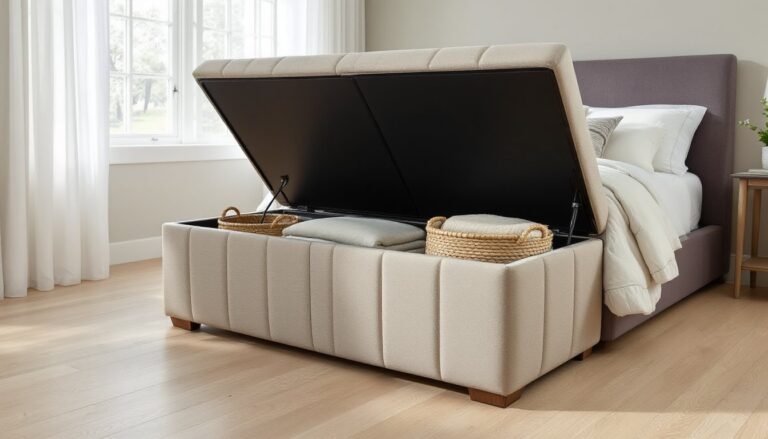
An ottoman storage bed (sometimes called a lift-up or gas-lift bed) uses a hinged platform that tilts upward to expose a storage cavity beneath the mattress. Unlike drawer-style storage beds, which offer divided compartments along the sides, ottoman beds dedicate the entire footprint under the mattress to open storage. The lifting mechanism typically relies on hydraulic gas struts or piston lifts, the same hardware used on hatchback car trunks, to counterbalance the weight of the mattress and platform.
Most designs hinge along the foot or head of the bed. Foot-hinged models are more common because they allow access without disturbing bedside tables or wall-mounted reading lights. The mattress stays secured to the platform with straps or a non-slip surface, so the whole assembly moves as one unit. When closed, the bed looks identical to a standard upholstered or panel bed. When opened, the storage depth ranges from 10 to 14 inches, depending on frame design and mattress height.
The gas struts do the heavy lifting, literally. Even a queen mattress weighing 60-100 pounds can be raised with minimal effort, though heavier memory foam or hybrid mattresses will require slightly more force. Most systems are rated for mattresses up to 150 pounds. If the struts fail or lose pressure over time (usually after 3-5 years of daily use), they can be replaced individually without rebuilding the entire frame.
Key Benefits of Choosing an Ottoman Storage Bed
Maximizing Storage Capacity
Ottoman beds make use of dead space. A queen-size ottoman bed can offer 20 to 30 cubic feet of storage, enough for seasonal bedding, out-of-season clothes, luggage, or bins of holiday decorations. Unlike traditional drawer beds, which lose space to drawer slides and dividers, ottoman designs dedicate the full under-bed area to storage. That’s comparable to adding a medium-sized closet without sacrificing floor space.
This layout works especially well in small bedrooms or studio apartments where every square foot counts. DIY enthusiasts exploring furniture building plans often appreciate how lift-top designs maximize vertical storage while maintaining a clean footprint. Because the storage is enclosed and out of sight, it won’t collect dust the way open under-bed bins do.
The downside? You can’t access storage while the bed is made, so this isn’t ideal for items you need daily. But for things you pull out monthly or seasonally, it’s hard to beat the capacity.
Ease of Access and Convenience
Lifting the entire mattress platform means there’s no digging around in narrow drawers or pulling bins out from tight corners. Everything is visible at once, and larger items (like rolled-up area rugs or stacked pillows) fit without folding or cramming. Families with multiple sets of bedding find this especially useful, swap out comforters or sheets without rummaging through drawer dividers.
Gas struts reduce the physical effort required, but it’s still a two-handed operation. People with limited mobility or strength may struggle, particularly with heavier mattresses. If that’s a concern, consider a hybrid design with both lift-top access and side drawers, or stick with a traditional full-size storage bed frame that uses pull-out drawers.
Installation is generally straightforward, but the struts do require clearance. Make sure there’s at least 18 inches between the top of the mattress and any overhead light fixtures or ceiling fans when the bed is fully raised.
Types of Ottoman Storage Beds: Finding Your Perfect Fit
Ottoman beds come in three main configurations: upholstered, wooden panel, and platform/minimalist designs.
Upholstered ottoman beds feature fabric or faux-leather wrap around the headboard and frame. They’re popular in contemporary and transitional bedrooms. Upholstery adds a soft, finished look, but it also traps dust and pet hair, plan to vacuum seams and tufting regularly. Most upholstered frames use stapled fabric, which can fray or loosen over time if the bed is opened and closed frequently.
Wooden panel beds (think slatted oak or walnut veneers) fit traditional, farmhouse, and mid-century aesthetics. They’re more durable and easier to clean than upholstered versions, and the wood joinery generally holds up better under repeated lifting. If you’re shopping used or building your own, check that corner joints are reinforced with brackets or dowels, simple butt joints won’t survive the lateral stress from lifting cycles.
Platform or minimalist ottoman beds skip the headboard and decorative details, focusing on function. These often use metal or engineered wood frames and are lighter overall, which makes assembly and future moves easier. They’re also less expensive, though they lack the visual warmth of upholstered or solid wood designs.
Some models include an integrated headboard with built-in shelving or USB ports. These add convenience but also weight, which can strain the lifting mechanism over time. Projects shared on sites like Young House Love often showcase creative headboard add-ons for platform storage beds if you’d rather keep the base simple and customize later.
What to Consider When Buying an Ottoman Storage Bed
Start with room dimensions and clearance. Measure the footprint of the bed frame (not just the mattress size) and add at least 2 feet on the access side so the platform can fully open. If the bed sits against a wall, you’ll need to pull it out slightly to lift the platform, or choose a side-opening model.
Next, evaluate the lifting mechanism. Hydraulic gas struts are standard and reliable, but quality varies. Look for struts rated for at least 100-150 pounds of lift capacity. Cheaper frames may use under-spec’d hardware that feels stiff or fails within a year. If you’re buying online, check reviews specifically mentioning the lift mechanism’s longevity. Replacement struts are available through hardware suppliers or online retailers for $20-40 per pair, but swapping them requires basic tools (socket wrench, screwdriver) and about 30 minutes.
Mattress compatibility matters more than with standard beds. The platform must support the mattress type and weight without sagging. Most ottoman beds use a solid plywood or slatted base. Memory foam and latex mattresses need solid support: innerspring and hybrid mattresses can work with slats, provided they’re spaced no more than 3 inches apart. If the bed comes with wide-gap slats, add a bunkie board or plywood sheet to prevent sagging and extend mattress life.
Finally, consider assembly complexity. Most ottoman beds ship flat-packed and require 1-2 people to assemble. Budget 1.5 to 3 hours depending on the frame’s complexity. You’ll need a power drill, Allen keys (usually included), and possibly a rubber mallet for tapping dowels into place. Some upholstered frames use cam-lock fasteners, which are faster but less forgiving if misaligned. DIY builders interested in beginner-friendly woodworking projects can find plans for custom lift-top beds that use simpler joinery and off-the-shelf hardware.
Installation and Assembly Tips for Your Ottoman Bed
Read the instructions twice before starting. Ottoman bed assembly isn’t complicated, but the sequence matters. Installing the gas struts at the wrong step can make it nearly impossible to attach the platform or align the hinges.
Prep your workspace. Clear a floor area at least 8 x 10 feet and lay down a moving blanket or cardboard to protect both the floor and the bed components. Keep all hardware sorted in a muffin tin or labeled bags, missing a single bolt at the end is frustrating.
Get a helper. Attaching the headboard, aligning the gas struts, and securing the mattress platform all go faster and safer with two people. One person holds components in place while the other drives fasteners.
Key steps:
-
Assemble the base frame first. Connect side rails, footboard, and headboard (if included) using the provided bolts and cam locks. Hand-tighten initially, then go back and fully tighten once everything is square. Use a carpenter’s square or measuring tape to check diagonal measurements, if they match, the frame is square.
-
Install hinges along the foot or head rail. These should be pre-drilled, but double-check alignment before driving screws. Misaligned hinges will bind when the platform lifts.
-
Attach gas struts. Most systems use a ball-and-socket mount. The strut’s fat end typically mounts to the fixed frame: the narrow end attaches to the lifting platform. Struts are under tension even when disconnected, wear safety glasses and keep your face clear when snapping them into place.
-
Secure the platform and test the lift. Before adding the mattress, open and close the platform several times. It should move smoothly without binding or uneven lifting. If one side lifts faster, check that both struts are installed at the same angle and that all fasteners are snug.
-
Add the mattress and any retention straps. Most platforms include hook-and-loop or elastic straps to prevent the mattress from sliding. Cinch these snug but not overly tight, you want the mattress to stay put, not compress.
Safety note: Never place hands or objects under the raised platform while adjusting hardware. Gas struts can release suddenly if a mount fails. If you’re drilling pilot holes or modifying the frame (for example, adding carpet squares to reduce noise), work with the platform fully lowered and supported by a sturdy block.
After assembly, test the lift mechanism monthly for the first few months. If you notice reduced lift force, the struts may need adjustment or replacement. Most manufacturers provide replacement parts, or you can source generic struts by matching the eye-to-eye length and force rating of the originals.