Table of Contents
ToggleSmall bedrooms demand smart furniture choices. When floor space is tight but overnight guests are frequent, a standard twin bed leaves homeowners stuck choosing between storage and sleeping capacity. A twin bed with trundle and storage eliminates that trade-off entirely, packing three functions into one footprint: primary sleeping surface, pull-out guest bed, and built-in organization. These multi-purpose beds have become a go-to solution for kids’ rooms, studio apartments, and guest bedrooms where every square foot counts. Understanding the construction types, storage configurations, and selection criteria helps DIYers and homeowners choose a bed frame that delivers years of reliable service.
Key Takeaways
- A twin bed with trundle and storage solves space constraints by combining three functions—primary sleeping surface, guest bed, and built-in organization—into a single footprint of just 38 by 75 inches.
- When fully extended, you’ll need approximately 150 inches of floor space to deploy both the main bed and trundle with comfortable walking room, making proper room measurement essential before purchase.
- Drawer storage offers easy daily access and is the most common configuration, while lift-up storage bases provide double the capacity (15–20 cubic feet) but require removing bedding to access contents.
- Weight capacity and construction materials matter significantly: solid wood frames support 250–400 pounds on the primary bed and handle repeated trundle operation better than budget particleboard frames capped at 200 pounds.
- Pop-up trundles raise the trundle mattress to equal height with the main bed, creating a king-size sleeping surface and solving mobility concerns, though they cost $50–100 more and require 14–16 inches of vertical clearance.
- DIY builders can construct a quality pine twin bed with trundle and storage for $150–300 in materials plus 16–24 hours of labor, and simple storage enhancements like drawer dividers and vacuum bags can double effective capacity.
What Is a Twin Bed with Trundle and Storage?
A twin bed with trundle and storage combines a standard twin mattress frame (typically 38 inches wide by 75 inches long) with a pull-out trundle bed underneath and integrated storage compartments. The trundle slides on casters or glides, holding a second twin mattress that sits 6–8 inches lower than the main bed when deployed.
Storage options vary widely. Some frames feature built-in drawers along one or both sides, while others incorporate lift-up bases that access a hollow cavity beneath the mattress platform. The drawer configuration typically offers 2–4 storage compartments, each measuring roughly 12–18 inches deep and spanning the width of the bed.
Construction materials range from solid wood (pine, oak, or maple) to engineered wood products like MDF or particleboard with veneer finishes. Solid wood frames handle repeated trundle operation better, with dovetail or mortise-and-tenon joinery at critical stress points. Metal frames exist but are less common in trundle-storage hybrids due to the difficulty of integrating drawer systems with tubular steel construction.
The trundle mechanism itself uses either a simple rolling system with four casters or a guided track system. Track-guided trundles stay aligned during extension but cost more upfront. Both systems should include a stop mechanism to prevent the trundle from rolling too far out.
Why Choose a Twin Bed with Trundle and Storage for Your Home
Square footage is the most obvious driver. A twin bed with trundle and storage occupies the same 38-by-75-inch floor space as a standard twin but accommodates two sleepers and eliminates the need for a separate dresser or under-bed bins. This makes them ideal for children’s bedrooms, especially in homes where siblings share a room.
Guest room flexibility is another major benefit. The room functions as an office, craft space, or gym 90% of the time, then converts to guest quarters in minutes. No need for a bulky queen bed that sits empty for months or an air mattress stored in a closet.
For rental properties and vacation homes, the trundle-storage combo reduces furniture costs and maximizes rental appeal. Hosts can advertise sleeping capacity for three or four guests in a single bedroom without cramming in multiple standalone beds.
Storage capacity matters more than many buyers initially realize. A typical four-drawer configuration offers 8–12 cubic feet of storage, enough for off-season clothing, extra bedding, sports equipment, or toys. That’s equivalent to a small dresser, freeing up closet space or eliminating the need for additional furniture.
DIY builders appreciate the straightforward construction. Many woodworking plans are available for captain’s beds with trundles, using dimensional lumber and basic joinery. The project requires intermediate carpentry skills but doesn’t involve complex angles or specialty hardware beyond drawer slides and casters.
Types of Twin Beds with Trundle and Storage Options
Built-In Drawer Storage vs. Lift-Up Storage Bases
Drawer storage is the most common configuration. Side-mounted drawers run on ball-bearing slides rated for 75–100 pounds, though cheaper models use plastic roller slides that wear out faster. Drawers typically sit on one side of the bed to accommodate the trundle on the opposite side, though some designs place drawers at the foot end.
Drawers offer easy access, no need to lift the mattress or disturb bedding. But, they reduce the trundle opening width. On a standard 38-inch-wide frame, side drawers consume 12–14 inches, leaving a narrower trundle space. This works fine for kids but can feel cramped for adult guests.
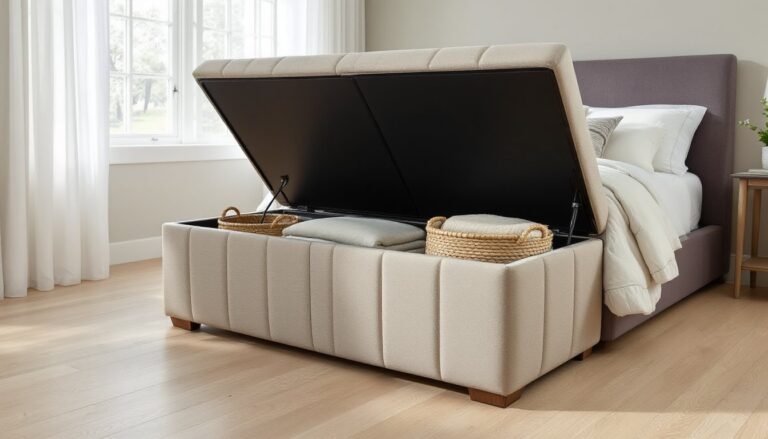
Lift-up storage bases use gas pistons or manual lift mechanisms to raise the entire mattress platform, revealing a storage cavity underneath. These provide maximum storage volume, often 15–20 cubic feet, but require removing all bedding to access contents. They’re better suited for long-term storage like seasonal items rather than daily-use clothing.
Lift mechanisms require proper counterbalancing. Gas pistons rated for the combined weight of the platform and mattress (typically 100–150 pounds) prevent the base from slamming shut. Budget models skip the pistons, relying on manual effort and a prop rod, functional but less convenient.
Some hybrid designs combine shallow drawers with a partial lift-up section, though these tend to be pricier custom builds rather than off-the-shelf options.
Pop-Up Trundles vs. Traditional Roll-Out Trundles
Traditional roll-out trundles sit 6–8 inches below the main mattress height. The trundle frame pulls straight out on casters, creating a lower sleeping surface. This height difference can be an issue for elderly guests or anyone with mobility limitations.
The lower profile does offer one advantage: headroom clearance. Since the trundle mattress sits low, it works under beds with as little as 10–12 inches of clearance. Most trundle mattresses measure 6–8 inches thick to fit this constraint, which limits comfort compared to standard 10–12-inch mattresses.
Pop-up trundles include a spring-loaded or manual lifting mechanism that raises the trundle mattress to the same height as the main bed. Once elevated, the two mattresses sit side-by-side at equal height, creating a king-size sleeping surface (76 inches wide when both 38-inch twins are aligned).
Pop-up mechanisms add 50–100 dollars to the frame cost but solve the stepped sleeping surface issue. They require more vertical clearance, typically 14–16 inches beneath the main platform, which can conflict with deep storage drawers. For this reason, pop-up trundles pair better with lift-up storage bases or minimal drawer configurations.
Installation note: pop-up trundles use a scissors-style lift mechanism similar to jack stands. Inspect the pivot points and locking pins regularly, as these bear significant load when the trundle is elevated.
How to Choose the Right Twin Bed with Trundle and Storage
Start with room dimensions and clearance. Measure floor space with the trundle fully extended, you’ll need roughly 38 inches wide by 150 inches long (12.5 feet) to deploy both beds with walking space. Account for door swings, closet access, and adjacent furniture.
Check vertical clearance if buying a pop-up trundle. Measure from the floor to the bottom of the main bed platform. Pop-ups need 14–16 inches, while standard roll-outs work with 10–12 inches. If headroom is tight, a full-size storage bed might offer more flexibility for certain room layouts.
Weight capacity matters for both the main platform and trundle. Quality frames support 250–400 pounds on the primary bed and 200–250 pounds on the trundle. Check the manufacturer specs, cheaper particleboard frames often max out at 200 pounds total, which doesn’t hold up for adult use.
Evaluate drawer slide quality if choosing a drawer storage model. Full-extension ball-bearing slides cost more but let you access the entire drawer depth. Side-mount slides are easier to install for DIY builds, while under-mount slides offer a cleaner look but require precise installation.
Material selection affects longevity. Solid wood frames cost 200–400 dollars more than MDF or particleboard but handle daily trundle operation better. Joints stay tight, and screw holes don’t strip out during assembly or future moves. If budget dictates MDF, look for frames with metal corner braces and through-bolted construction rather than cam-lock fittings.
For DIYers building from scratch, project tutorials provide detailed cut lists and assembly sequences. Expect to invest 150–300 dollars in materials for a solid pine build, plus 16–24 hours of labor depending on skill level. Tools required include a circular saw or miter saw, drill/driver, pocket hole jig (optional but helpful), and clamps.
Consider mattress compatibility early. Trundle mattresses max out at 6–8 inches thick for standard roll-out designs, limiting options to memory foam or low-profile innerspring models. Pop-up trundles accommodate standard 10-inch mattresses, improving guest comfort but raising the total bed cost.
Creative Ways to Maximize Your Twin Bed Storage Space
Divide drawers with custom organizers. Deep 18-inch drawers quickly become junk bins without internal dividers. Cut 1/4-inch plywood or hardboard into strips, creating compartments for specific items, socks, craft supplies, LEGO sets, or charging cables. Adjustable drawer dividers from closet organizer systems work too, though custom-cut inserts fit odd drawer dimensions better.
Use vacuum storage bags for seasonal items. Bulky winter coats, blankets, and comforters compress to half their volume, doubling effective storage capacity in lift-up base compartments. This works best for long-term storage rather than items accessed weekly.
Install drawer pulls or handles on trundle frames. Factory trundles often lack good grip points, relying on awkward finger holes or edge grabs. Adding a simple drawer pull to the trundle footboard makes deployment easier, especially for kids. Use low-profile pulls (projecting less than 1 inch) to avoid catching on the main bed frame during storage.
Label drawer fronts or use clear-front drawers if multiple people access the storage. Kids’ rooms benefit from picture labels or color-coding systems. Guest rooms can use simple text labels identifying linens, toiletries, or extra pillows.
Leverage vertical space above the bed. Wall-mounted shelves or pegboards above the headboard keep books, alarm clocks, and personal items accessible without consuming floor space. This doesn’t directly relate to the bed’s built-in storage but complements the space-saving strategy.
For advanced DIYers, adding a false bottom to deep drawers creates hidden storage for valuables or out-of-season items. Cut a piece of 1/2-inch plywood sized 2 inches shorter than the drawer interior on all sides. Rest it on 2×2 cleats screwed to the drawer sides, 3–4 inches above the drawer bottom. The concealed space underneath holds passports, spare cash, or small electronics.
Maintain drawer slides and casters to extend service life. Vacuum out dust and debris from ball-bearing slides every 6–12 months. Wipe down with a dry cloth, then apply a thin bead of silicone spray lubricant. For trundle casters, check that wheels spin freely and replace any that wobble or stick. Most casters use a grip-ring stem that pulls straight out for replacement, no tools required.
Finally, builders following detailed plans can incorporate additional custom features like built-in nightstands, headboard cubbies, or USB charging ports integrated into the side rails. These upgrades add 4–8 hours to build time but eliminate the need for separate bedside tables in tight spaces.